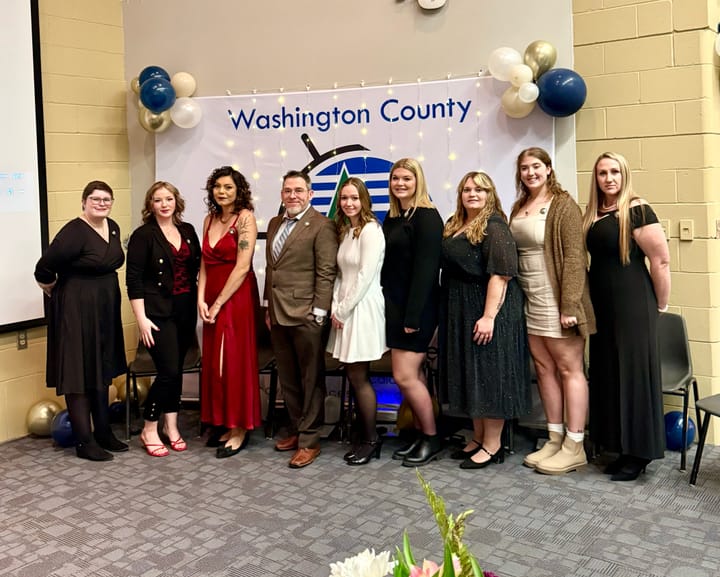
New social services agency covers three counties
Jason Parent knows he faces a challenge. In the aftermath of the closure of Downeast Community Partners (DCP) after years of financial mismanagement, he now oversees the soon-to-be-official Community Action for Aroostook, Washington and Hancock Counties (CAAWHC)...
Jason Parent knows he faces a challenge. In the aftermath of the closure of Downeast Community Partners (DCP) after years of financial mismanagement, he now oversees the soon-to-be-official Community Action for Aroostook, Washington and Hancock Counties (CAAWHC), a community action agency whose service area will cover 35% of the area of the State of Maine. But even as his team continues to build out the remaining makeup of the new agency, including a new board of directors with representatives from each county, Parent emphasizes their commitment to seamlessly delivering critical services its clients depend on, from Head Start and home heating assistance to occupational training and community food cupboards, while developing relationships of trust and support with the many communities within its reach.
As CEO of what is still officially known as the Aroostook Community Action Program (ACAP), Parent, along with his team, is working to make all services accessible to its far‑flung communities. While ACAP's offices are in Presque Isle, "We aren't using a hub‑and‑spoke model. Our director of operations, Tracy Collins, works from the Calais city office. We are in discussions to share space with the Sunrise County Economic Council in Machias. We have a mobile service unit put in place for spring, summer and fall."
In some ways, he sees that the combined agency can deliver services more efficiently. "I think there has always been a doughnut hole for services in Danforth and other towns in northern Washington and southern Aroostook counties. I am looking forward to rolling out the new brand along the border of the two counties. I believe it will raise awareness, and we will be more connected. I strongly believe there are more people who can benefit, but access is critical."
He also sees potential cost savings to be had by combining administrative functions across the three counties.
Parent travels throughout the three counties, wherever he is invited, speaking to select board members and community groups, hearing their concerns and helping them to understand what community action agencies do, why they are important to life Downeast, and why they are worth supporting. His agency has sent letters to each municipality in its territory, requesting an opportunity to visit and give a presentation to the municipal government and the public.
Parent states that building trust is essential in working with struggling communities. He is not surprised when the first reaction is skepticism, but he feels ready to "demonstrate accountability," explaining the capacity his agency has and the standards it holds.
He is proud of his organization, both for the quality of the services it provides as well as its efficiency. ACAP has been held up as a national model for its Whole Family approach, which has a one-stop goal for clients for services rather than sending them to multiple offices, while modeling fiscal discipline.
"We have annual fiscal audits," Parent says. "We have nine organizational standards we must provide to the state each year. This system was begun six years ago, and we have achieved a 100% score on each of them each year."
Uncovering deep problems
Local community action agencies were created by the 1964 Economic Opportunity Act, with a mission to fight poverty in their communities. Federal Community Services Block Grants, distributed to states to allow them to address local needs, are the primary funding mechanism, supporting programs such as Head Start, employment training and heating assistance.
Until 2025, Downeast Community Partners (DCP) had been the community action agency for both Washington and Hancock counties. That's when, echoing the financial woes of Washington County's government, years of mismanagement at DCP, including inadequate record keeping and a lack of financial audits, reached a critical mass.
The DCP board of directors had hoped to put the agency back on track. Former state Rep. Anne Perry joined the board in late 2023 before being named chair in 2024. "I did have a sense of problems before I joined the board of Downeast Community Partners. When I was in the state legislature, constituents reached out to me expressing problems with access to say, housing or other services, so I knew there were problems with communication and efficiency, but that was a person outside looking in. I thought I could help, and we could resolve this."
But the problems were deeper than she had realized. DCP board and staff were unable to assemble adequate financial records to complete audits for 2022 or 2023. "We were given timelines from our state and federal funders that we couldn't meet. Aroostook CAP was the obvious place to go. It has a rural population with a lot of the same issues as Hancock and Washington counties, and it had a great reputation. ACAP was very committed to services and that the services in our community continue. The most important thing is that people be well served."
Perry reflects, "I don't think the problems at DCP can be pointed to one place. There were issues where some staff simply lacked knowledge of the job. There was a lack of systems that kept track of finances, that got lost in the shuffle of people coming and going because of the amount of turnover. There was a new executive director and finance director when I came on the board, and then we hired those positions again. We had one executive director resign for health reasons. There was a great deal of turnover in the entire financial staff."
Looking at how this transpired and ways to prevent it from happening again, she remarks, "I think I would say the most important thing is that boards, no matter what agency, need to be very well educated about our fiscal responsibility. The federal Community Action Program (CAP) actually has great training on financial responsibility, believe it or not, on YouTube, about what we should be expecting around financial reporting. Board members are volunteers, but we need the right education so we know to ask the right questions."
Reaching out for help
In January 2025, DCP first contacted ACAP. "Their financial director assisted us, in trying to pull this together, but we were not able to put an audit together in time for grantors," says Perry. "What we needed to do was save the programs, so we began serious conversations with ACAP to pick up programs that would not be given to us again and worked to make sure that transfer was as seamless as possible. We were very committed to services in these two counties. Those services needed to stay."
Of the work to have ACAP take over DCP's programs, Perry says, "It was a deliberative, long process. It takes time to create governance for a new CAP agency. It was really excellent teamwork. Jason Parent and the people working with him have been very collaborative."
Parent emphasizes the intentionality as well. "First it was a contract for shared services with our financial director." Then DCP lost funding for the Head Start program. "By summer, the mounting liabilities for DCP became untenable." The State of Maine filed liens of $4,022,149 against DCP properties when the agency could not provide enough evidence that it had actually fulfilled its contracts with the state.
Because of DCP's liabilities, a merger was not possible. They had to work with each DCP funding source to recreate programs as part of ACAP.
They were successful. Except for transportation services, which were taken on by Waldo Community Action Partners, and the maternal and child health nursing program, which the state declined to fund in northern Maine, all DCP programs continued without a break in services. Both Perry and Parent agree that this was the most important outcome.
Of the work to have ACAP take over DCP's programs, Perry says, "It was a deliberative, long process. It takes time to create governance for a new CAP agency. It was really excellent teamwork. Jason Parent and the people working with him have been very collaborative."
Parent emphasizes the intentionality as well. "First it was a contract for shared services with our financial director." Then DCP lost funding for the Head Start program. "By summer, the mounting liabilities for DCP became untenable." The State of Maine filed liens of $4,022,149 against DCP properties when the agency could not provide enough evidence that it had actually fulfilled its contracts with the state.
Because of DCP's liabilities, a merger was not possible. They had to work with each DCP funding source to recreate programs as part of ACAP.
They were successful. Except for transportation services, which were taken on by Waldo Community Action Partners, and the maternal and child health nursing program, which the state declined to fund in northern Maine, all DCP programs continued without a break in services. Both Perry and Parent agree that this was the most important outcome.